Wednesday, 29 March 2023

Breaking Bad


The story   


The overview of Breaking Bad is the story about Walter White, an overqualified chemistry teacher who also works at a carwash to make ends meet for his pregnant wife and teenage son who has cerebral palsy. Walter is miserable in his life, going day by day until he collapses at his job at the carwash. From there his life takes a turn because he is informed that he has stage 3 cancer, inoperable, and has at most two more years to live. Walter turns to crime using his vast skill set of chemistry to make money for his family when he inevitably dies. 
  

Character study   


Walter is a 50-year-old chemistry teacher that also works at a carwash. Walter is a very passive, timid, subdued man who takes things as they come. He once had a promising career in science and chemistry but now is stuck washing the tires of one of his most troublesome high school students. Walter is unfulfilled, just focused on providing for his family. When he discovers he will die soon his life is then filled with a purpose unlike his aimless day by day. He must make enough money to take care of his family when he goes. So, he partners up with Jesse Pinkman, a former deadbeat student of his that now makes and sells heroin. At first Walter is very unsure and scared of what will happen if they are found out. This is shown when they first encounter adversity with local drug dealers and Walter is forced to defend himself by making phosphate gas and kills one of them. Walter's response is human. He is a nervous wreck demonstrated by him throwing up and panicking as he hears sirens in the distance. Over time his humanity, and care for others other than himself decreases as the seasons continue. Walter is told he is recovering and is in remission. This is devastating for him because he committed multiple crimes with the understanding that would die, and everything will go to his family. He would not have to live and take reasonability for his actions. This is another turning point for Walter as he does not want to stop making heroin because he is good at it and makes him feel alive. His purpose now switches again from simply providing for his family to his own interests despite what is best for his family. By the end of the show Walter has made a 360, he is ruthless, cruel, calculating, and is in power.  


Scenes  


One of the most powerful scenes that shows this character development is the pilot episode and one of the later seasons after he becomes Heisenberg. It contrasts with Walter, his unsure timid self in the MRI, to his later self as Heisenberg, who is ruthless. You can see how scared Walter is in his face in the pilot episode as he fears the worst. But Heisenberg is almost smiling, he is smug because at this point, he still thinks he is going to die and get away with it. He made the best product, a genius among his peers, and is the king of his world. 


Sunday, 19 March 2023

Chapter 6: Editing


In chapter 6, shots are edited in many ways to show the story. Editors effectively make the end result of a movie by leaving in scenes, making snapshots, and continuous shots. It helps portray emotions in build ups, climaxes, and the peak. They do this by leaving in frames or taking away frames to make it faster paced. But as time moves on and film develops editors are leaving in more frames for the viewer to process the information better. This is because of the content curve which is flexible with the amount of information being given. For example, reading text or having complicated frames can require more time to process and understand. So, editors give more time to these scenes or after the scene is finished to allow for the viewer to come to their own conclusions.  

To tell a proper story requires rhythm of which the editor puts most of their effort into. The timing and pace of a scene is important to keep. This is easier to see like in movies like Creed where it's physical. The punching of the bag keeps a pace that can transition into the next scene and the viewer can expect the same pace to be kept. Or in less physical films it can be seen with crowds in busy cities, restaurants, high schools, etc. With the pace of the crowd, people walking, and talking can carry their own rhythm. 

Additionally, most editing is natural with the flow of the scene like old Hollywood or making the editing noticeable like with Hereditary and the jump cut of Peter and his mother talking in her dream. It shows the buildup, pace, and high stress of the scene to the climax. As her and Peter are talking about their past, and her attempt to kill her son to save him. The cuts back and forth as the conversation gets more emotional and faster than leads to the jump cut of her waking up. Which shows the editor's choice and structure of the scene to properly illustrate to the viewer the unresolved tension between her and her son from her actions she did in the past. As well as their current space and unfamiliarity they have for each other over the years.


Chapter 5: Cinematography


In chapter 5 it discusses the cinematography that goes behind a director's choice in lighting, distance, and quality. One that I wanted to force on was the hard and soft lighting. These choices in which one is used can change the scene and depth. Hard lightning is crisp, harsh, and more focused while soft fills the screen with an even level of light. To create either it requires just changing the distance and adjusting the light source. 


This can change the feeling in the scene with harsh lighting the further the source of light helps create harshness. The opposite is true for soft, the closer you are to the light source the softer the outcome. Diffusion is confused for soft light because they look very similar but it's different in how it is created. Diffusion, unlike soft light, isn't made by being close to the light source but is instead created by making the light pass through a material or object to create it. This scatters the light source making a more even distribution of the light across whatever the director wants for the scene.  


What is the significance of these in films? Well, these lightening methods create moods, setting, and themes for the director to tell the story. If the story takes place in the winter, it's best to use more harsh lighting methods like a bigger area with light further away to represent the weather and overall mood. If it is during summer, softer lighting will make it seem warmer if the light source is close by.


Thursday, 2 March 2023

Get Out (2017)


Story   


Get Out is based around Chris and his girlfriend, Rosa of four months. They have been in a serious relationship and are moving to the next stage in their relationship to meet her parents. Chris is not completely comfortable with meeting her parents based on the color of his skin and their possible reactions to it. He wants things to go smoothly. Chris's fear is realized when he goes to Rosa’s parents, and they have a weird atmosphere in combination with their selected help around the house. Which are people of color. He is made to feel like an outsider by her family and their friends as the movie continues by focusing just on his genetics and race.  


Cinematography   


Jordan Peele’s use of close shots and wide of Chris' face, you can feel the emotion he is feeling. The wide shot of Chris as he walks up to the house shows the uncomfortable feeling he had when he first met Rosa’s parents. The close ups all throughout the film add to the uncanny feeling that something is wrong. For example, the close up of Chris as he is hypnotized. His expression of pure helplessness and the tears well up and fall help the viewer feel the sense of utter horror as he is put in the sunken place. The combination of this and the close-up of Missy as she smiles at the trauma, she is putting Chris in, making him relive the worst of his memories. I find the following scene most powerful as he is put in the sunken place he is put in a photo like lens as he looks out through the window of his own eyes. Unable to do anything. As Missy walks up to him closely we see it as far away as Chris does, it is like looking through the lens of his photographs.


Another scene that is immensely powerful is the last part of the film where he is strapped to his chair unable to move as he is in the final stages of the operation to transfer consciousness. Chris has a history of picking at his bed post, chair, or taping whenever he is stressed as a coping mechanism. In this scene he naturally starts picking at the chair which has cotton underneath the leather. Jordan Peele uses the cotton as symbolism for black history. Because what saves Chris in this scene is him picking the cotton out of the chair and placing it in his ears to avoid being hypnotized. The following scenes follow the same symbolism. With Rosa as well when it cuts to her, she is exceptionally clean, formal, and not a hair out of place. She is sitting very straight as she eats from her cereal and milk. Which is noticeably separated. The colored fruit loops are in a different container as she picks from them to eat and as she does so to finish her shallow she then drinks from the milk with a straw. This symbolism shows her true character gives the feeling of racism throughout history.  


Cultural relevance   


Get out is culturally relevant because in today's society we still have harmful stereotypes and institutional racism that follows us from our history of slavery. In our culture today there is a lot of progress in the ways of ending racism, but it is still prevalent in how we treat people of color and how we expect them to act. This is shown firsthand when they hit the deer and the officer questions Chris asking for his ID when he wasn't driving. Chris naturally complies because it's an expectation of him to come off as unthreatening to the police officer to avoid further trouble. Additionally, Rosa’s parents in order to comfort Chris about the people of color working for them. They tell Chris that they would vote for President Obama for a 3rd time if possible and other comments that are supposed to be compliments for his race which are just backhanded. Jordan Peele shows the relationship many white people have with people of color as to not seem racist or make it seem like they are on the same side which does not help.


Sunday, 26 February 2023

Marie Antoinette


Marie Antoinette - La Reine rebelle // The Rebel Queen

Story  

Marie Antoinette is a princess of Austria and is to marry the Dauphin of France to unite both countries “prior to the Seven Years' War (1756-1763)” (Harrison W. Mark). She is stripped of her simple life and of everything belonging to that of Austria and is welcomed as the new potential queen of France. But she has trouble growing accustomed to the many rules as well as consummating her marriage with her husband and producing an heir. Even once this is achieved, she is not in the clear. She still struggles with the population of France seeing her as the root cause of their suffering vilifying her.  

Cinematography  

Mise-en-scène

Throughout the movie, there are many contrasting visuals, one at the beginning of the film. At the border of the two countries when she is to cross over to France, she is in her Austrian clothing which is baby blue, soft, natural look. But once she steps out onto France territory she is dressed up in a puffy, constricting, unnatural, and stark blue. Her hair is more white and extra extensions to exaggerate it. This fashion is her new norm to her husband and the royal court. Later in the film when Marie’s brother comes to visit her, he comments on her hair that is so tall. 

Her life is constrained to the high royalty lifestyle as a young teenager and thus she acts out with food, jewelry, and partying. This is shown with the director's choice of music and even in one scene there is the use of converse along with the other shoes. Given that in this era converse did not exist but they are strongly associated with teenagers.  

Further, Marie's long drawn-out scene where she is coming to France for the first time. She has a long scene of her walking up to her new house surrounded by people not talking but staring at her like some creature. She takes in everything. The new culture, new life, and as she looks around it makes the audience look around as well. The comparison is made even more unique as Marie first enters her room for the first time looking around and seeing everything that her new room has to offer. Which is covered in gold, white, and richness which is contrasted to the last scene in the house of the room destroyed because of the people's dissatisfaction with her. 

Cultural relevance  

 A scene done well is her laying her head down on the balcony when the mob came to their house. As they yell, she bows and places her head gently on the banister as a moment of silence paces through. Then the yelling continues in greater volume as she lifts her head and looks upon the angry mob. This is relevant because the director foreshadows what will happen to her. She will be executed. Despite her caring attitude that is shown throughout the film it was suspected that “Marie Antoinette was deliberately targeted in order to bind the French together in a kind of blood bond.” (Antonia Fraser)


Sunday, 12 February 2023

Skinamarink


 Story    

I watched Skinamarink and it's a different film than most. The movie starts out with two children waking up in the middle of the night to their father missing and any access to the outside world closed off. This movie then follows the very basic fear children have when they are left alone in a familiar yet different place. Skinamarink is based around the perspective of children and often we are limited to how they perceive what is happening and limitations as young kids of four and five.  


Cinematography    


 Skinamarink uses different angles in an analog horror genre retro style. So, the entire movie is in snap shots of the entire house. Most often the house is in darkness and so the film uses the camera to try to adjust to the dark to show the stifling feeling the children are feeling. If the house is not in darkness, it is in the harsh colors of pink or orange, but it is a dark harsh kind of light. There are scenes where the camera is in the viewpoint of the child and it's terrifying because we are in the same position as the child. Helpless and afraid. One Thing I noticed throughout the film is that the children used flashlights and I didn't understand why when they had electricity and could flip the light on. But the kids are too short to reach the light switch. And by watching it's more evident because they are so low to the ground.  

Further, they can't fully comprehend what is going on, just that something isn't right, so they watch cartoons during the film and sleep downstairs where it isn't scary. There are also many deeper meanings throughout the film that predict the end. One of them is the cartoons that the kids watch. It tells a lot of what will happen or has happened. Skidamarink is slow and methodical to demonstrate the feeling of fear. Because when we are scared it seems slower and the director exemplified this.  

Lasty, the audio was used as a tool to tell the story. The film is quiet and when there is noise it's in lower tones. The children whisper the entire film, the parents whisper, with the only outlier being the cartoons. But even then, it doesn't disrupt the overall blanket of fear and uneasiness over the film.  


Cultural relevance  


This is culturally relevant to all children in a way with the basic fear of being alone in the darkness and a child's outlook on everything. While this movie isn't for everyone, and a lot of the films have darker undertones, the film is unique in its attempt at a new kind of horror. 


Friday, 3 February 2023

Stanley Kubrick one-point perspective


Chapter 2 

    I watched Stanley Kubrick's use of the one-point perspective, and it frames the scene in the center. It draws all the attention to the center of the screen, usually down a hall, long passageway, or a room to emphasize the distance and openness of the room. Specifically, movies like The Shining (1980) where he used this method. It works well to show the creeping isolation the family is experiencing and the Eerie feeling of insanity. It holds the viewer hostage to where they can look. They are locked in and see what the director wants them to see. The slow movement of the camera to the center of the one-point perspective can be scary as we have no choice in the matter.  


    Further, another scene in The Shining (1980) when they are walking in the maze it has a feeling of claustrophobia because the walls of the maze are so close, and the point is the mother and son walking infinitely down the maze to an unknown point. This assists in the thematic intent that the director wants for us. The director's intent is to make us feel uneasy, stressed, and not in control in these scenes. Which works well in this movie's context because the movement is slow and deliberate following the characters.  


    Additionally, in this scene the one-point perspective Kubrick uses color. The color is the harsh dark green of the bushes of the maze in comparison to the mother's harsh vibrant red. It compliments in such a way that it draws the eyes. As well as making it feel as if they keep walking that the maze’s darkness is swallowing its new victims.  

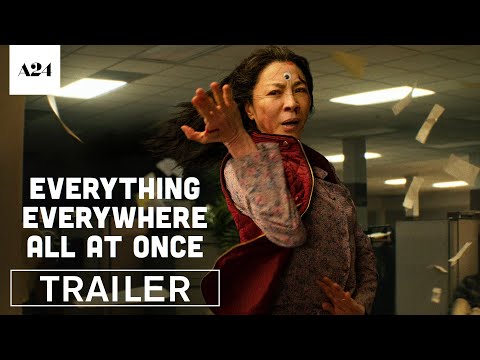
Everything Everywhere All At Once

         Everything Everywhere All At Once is a film that was entertaining from start to finish. Outside of Swiss Army Man  I've never s...